
It has to be usable
No volume exists to be read once and shelved. Each one carries an instrument, a script, a protocol or an exercise — something the reader applies the same week, in a conversation or a decision they were already going to have.
Est. as a publishing house · English & Spanish
Brightway Academy is an independent digital publishing house. We take subjects that are usually delivered as theory — how people manage emotion, hold a difficult conversation, repair a relationship — and publish them as short, applied volumes that state where their ideas come from.

What Brightway is
They are not a marketing promise. They are the checklist a manuscript has to clear before it becomes a book — and the reason a Brightway volume reads differently from a downloadable PDF.
No volume exists to be read once and shelved. Each one carries an instrument, a script, a protocol or an exercise — something the reader applies the same week, in a conversation or a decision they were already going to have.
Every volume names the research and the authors behind it, and names what it does not reproduce. We publish the reading list, not just the conclusions. Almost nobody at this price does it; it is the whole reason to trust the page.
Educational material, yes. Clinical diagnosis, therapy, or a professional credential, never. Where a reader should see a licensed professional instead of a book, the book says so. The declared limit is part of the product.
The catalogue
Each collection is a set of short volumes on one territory, designed to be entered at the title that matches the reader's situation — not read front to back.
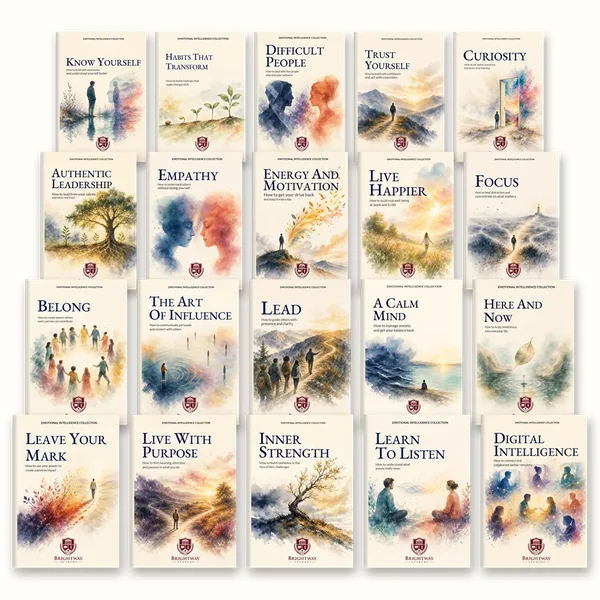
Twenty volumes on self-awareness, habit, conflict, focus, empathy and leadership — the skills that decide how a working life actually goes. Built on an editorial reading of the emotional intelligence literature, from Salovey and Mayer's original 1990 paper onward.

Twenty volumes on what couples actually argue about: the fight that keeps returning, broken trust, jealousy, resentment, money, the mental load, mismatched desire, distance. Built on the couples research and clinical literature — observational studies of conflict and repair, emotionally focused therapy, adult attachment.

Twenty short guides for the hardest moments of raising children: tantrums, homework battles, screens, the first phone, the teenager who stops talking, anxiety, siblings, limits without shouting. Built on developmental psychology and behavioural research, from emotion coaching to authoritative parenting, turned into exact words and five-minute exercises.

Read the reference. Then write the thing people can use.
The editorial brief, in one lineHow we work
The same five stages, every title. The stage that takes longest is the first one — and it is the one that decides whether the book is worth publishing.
The subject is mapped against its primary literature: foundational papers, the clinical work, the standard reference books. What the evidence supports gets separated from what is merely popular.
The volume is outlined chapter by chapter around one concrete problem the reader has, with the source behind each chapter recorded before a word is written.
Written as an original synthesis in plain language — the ideas reorganized and explained in our own voice, never a summary or a rewrite of somebody's book.
Each chapter is given its instrument: the script, the exercise, the check-in, the seven-day plan. If a chapter cannot produce one, the chapter is usually not needed.
Claims are checked back against the sources, the reference list is published, and the boundary is written in: what this material is, and what a reader should take to a licensed professional instead.


The research foundation
Our volumes are original editorial work, not summaries — but the ideas in them have authors, and those authors are named. Below is a sample of the researchers and clinicians whose work informs the two collections. The complete reference list, organized by collection and by subject, is public.
What you can count on
They hold for the twenty volumes already in print, and for everything we publish after them.
An independent publishing house, not a content farm. Every volume is read and approved by a person before it reaches a reader.
The research and the authors behind a volume are credited in the book and on this site, so you can always go to the original.
Each volume carries an instrument, a script or an exercise you can apply the same week. That is the test a manuscript has to pass here.
One payment, permanent access, no subscription and no renewal. Download it once and it stays on your own devices.
Our story
On one side there is the research — patient, tested, and almost unreadable outside a university library. On the other there is the advice industry: quick, confident, and mostly made of nothing.
Between the two stands a person with a real problem. A conversation they have been dreading for a month. A habit that has outlived every promise to break it. A marriage that went quiet somewhere and never said when. For that person there was plenty to read and almost nothing to use.
Brightway Academy exists to close that distance. We begin every volume in the literature and end it in something you can do on a Tuesday night — a sentence to say, an exercise to run, a plan for the week. The reading list goes in the back of the book, printed, so you can check our work and go further on your own.
We are small on purpose. There is no guru on our covers and no faculty to enrol with: the imprint signs the work, and each volume is judged on one thing only — whether anything actually changed after you read it.
The name is a promise about direction, not a claim of standing. A bright way through a subject that usually arrives as fog.